80/20 applies · 80 price, up to 20 specific-goal points
BidderBid price (R)Goal pts (0-20)
Scores
- 1YouWinsR1 050 000 · +5% on lowest96.00Price 76.00 + specific goals 20 = 96.00
- 2Competitor BR1 100 000 · +10% on lowest82.00Price 72.00 + specific goals 10 = 82.00
- 3Competitor AR1 000 000 · lowest80.00Price 80.00 + specific goals 0 = 80.00
How the scoring works
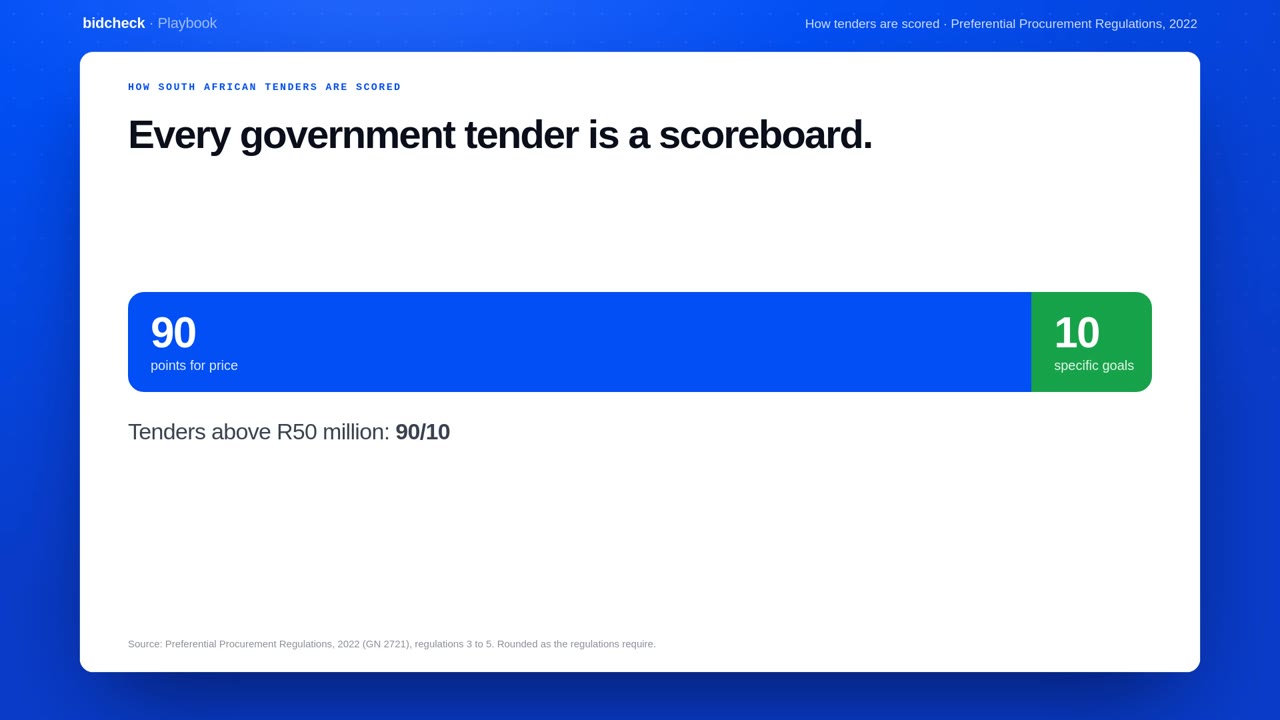
Under the Preferential Procurement Regulations, 2022 (in force since 16 January 2023), a tender worth up to R50 million (including taxes) is scored out of 100 with the 80/20 system: 80 points for price and up to 20 for the specific goals the buyer sets. Above R50 million it is 90/10.
Ps = 80 × (1 − (Pt − Pmin) ÷ Pmin)
Ps is your price points, Pt your price, and Pmin the price of the lowest acceptable tender. For 90/10 replace 80 with 90. The specific-goal points are added and the total is rounded to two decimals. The highest total wins, subject to section 2(1)(f) of the Act.
What to remember
- The buyer must state the specific goals and the points for each in the tender documents. There is no fixed points-per-level table, so use the points that tender offers.
- Twenty points can offset a price gap of up to 25% on 80/20 (10 points about 11% on 90/10). Treasury's own guidance gives these two figures.
- On an exact tie, the tender goes to the bidder with more specific-goal points, then to a draw of lots.
- Functionality comes first. A bid below the stated minimum is disqualified before price is scored, and the criteria cannot be changed after publication.
- Income-generating tenders (leases, disposals) use the highest bid instead of the lowest and are not covered here.
Sources
- Preferential Procurement Regulations, 2022 (Government Notice 2721, Gazette 47452), regulations 3 to 5 and 8
- National Treasury: FAQ on the Preferential Procurement Regulations, 2022 (the 25% and 11.11% premiums)
- National Treasury Instruction Note on functionality (September 2010)
Price it properly, then check you qualify.
The Pricer builds a traceable estimate and shows which system applies to your tender. Eligibility shows what could disqualify you first.